
5 Signs You've Outgrown Point Solutions

Why Leading Institutions are Moving to a Unified Platform


Every new technology investment is made with the best of intentions. A workflow tool solves one department's challenge. A reporting platform improves visibility. A new application digitizes a manual process. Over time, each investment delivers value.


But as institutions continue to modernize, these independent solutions often create a new challenge: operational complexity, multiple vendors, duplicate integrations, inconsistent user experiences, fragmented data, and separate governance models. And now, AI initiatives layered on top of an already disconnected technology landscape.


How to Know It's Time for a Different Approach

 If several of these challenges sound familiar, it may be time to rethink not just the applications you're using—but the platform that connects them. 

Every Department Buys Its Own Software

As departments solve problems independently, institutions often accumulate multiple workflow, reporting, and collaboration tools that perform similar functions. While each purchase may solve a local need, the result is an increasingly fragmented technology ecosystem that is difficult to govern and expensive to maintain.

The Impact
Higher licensing costs, inconsistent user experiences, duplicate capabilities, and limited visibility across the institution.
A Better Approach
Standardize on a common platform that enables departments to build the solutions they need while sharing the same governance, security, integrations, and user experience.
Every New Project Requires Another Integration

Every new application introduces another API, another vendor relationship, another maintenance cycle, and another point of failure. As integration requirements grow, IT teams spend more time connecting systems than enabling innovation.

The Impact
Longer implementation timelines, increased maintenance overhead, and growing architectural complexity.
A Better Approach
Reduce integration sprawl by adopting a platform where workflows, reporting, AI, and institutional data operate together from a shared foundation.

Leadership Can't Answer Simple Operational Questions

Technology should improve institutional visibility—not make it harder to understand what's happening across campus. Yet many institutions still rely on spreadsheets and manual reporting to answer basic operational questions.
Where are approvals delayed? Which departments have the largest backlogs? What processes require the most administrative effort? When information lives in disconnected systems, gaining insight becomes increasingly difficult.

The Impact
Slower decision-making, limited transparency, and missed opportunities for operational improvement.
A Better Approach
A unified platform brings together data, workflows, and reporting to provide real-time visibility across institutional operations.

AI Has Nowhere to Plug In

AI is becoming part of everyday work across higher education, but disconnected systems make it difficult to deploy responsibly. Without shared data, governance, and workflows, AI often becomes another isolated tool rather than an institutional capability.

The Impact
Shadow AI, inconsistent outputs, governance concerns, and increased compliance risk.
A Better Approach
Build on an AI-native platform where institutional knowledge, workflows, permissions, and governance are already connected—creating a secure foundation for responsible AI adoption.

IT Spends More Time Maintaining Software Than Enabling Innovation

Technology leaders want to focus on strategic initiatives that improve institutional outcomes. Instead, many teams spend their time managing software upgrades, supporting duplicate platforms, maintaining integrations, and coordinating multiple vendors.

The Impact
Innovation slows as operational maintenance continues to grow.
A Better Approach
Consolidate around a connected platform that reduces administrative overhead, simplifies vendor management, and gives IT more time to focus on modernization and institutional strategy.

Point Solutions vs. Platform Thinking


The institutions making the greatest progress aren't simply buying more software—they're simplifying the technology landscape underneath it.

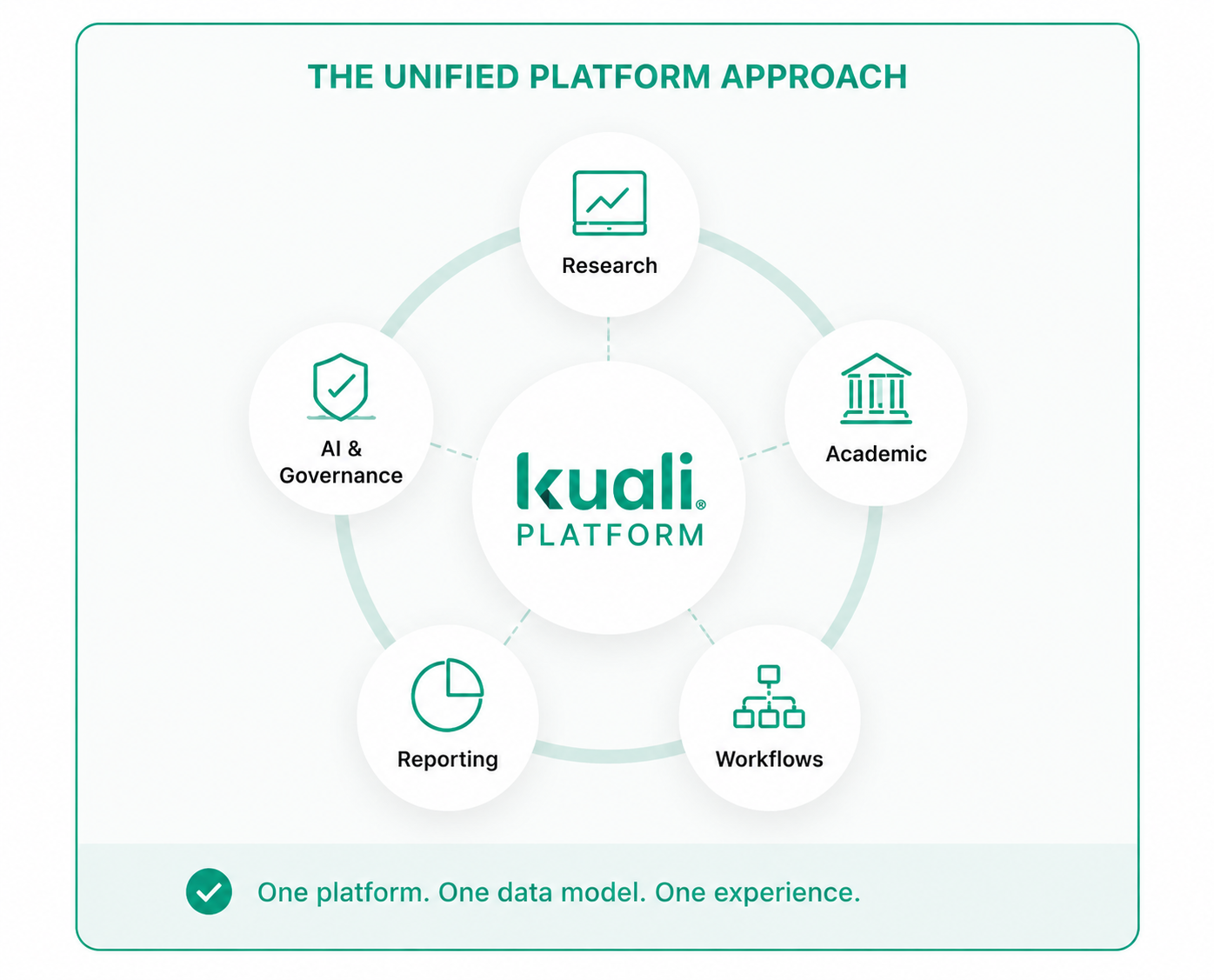
Rather than managing separate systems for research administration, workflow automation, reporting, AI, and governance, they're bringing these capabilities together on a shared platform. The result is fewer integrations, stronger governance, better visibility, and a technology foundation that is ready for the next generation of AI-enabled operations.

A unified platform isn't just a more efficient architecture—it's the foundation for a more agile, connected, and future-ready institution.